
Altar and Tools
Everything You Need To Know
About Your Wicca Altar
What really is an altar? How do you create and tend an altar? And why would you want an altar in the first place?
Fabulous questions! I'm glad you asked.
Let's start at the beginning - the why - and work our way down to the details - the how.
Why Is An Altar Important?
Any altar is a symbolic manifestation of your innermost self.
It is an expression of your heart's longing and your soul's potential.
It is also a focal point for your devotion . . . A spiritual practice arena for devotion to the Divine.
Temples Within And Without
We each have a Temple in our inner hearts. And any spiritual process is about entering and worshiping there.
But it's not easy to access something so abstract.
So, like your symbols and tools and Gods and Goddesses, you create something that comes through the gate of your senses. Something you can see and smell and touch. Even hear and taste, if possible.
The more senses you engage, and the more you balance your sense perceptions, the more you can access the spiritual levels that you seek.
In this context, altars are not some esoteric mystery, but the most natural expression of what has value to you.
Natural Altars
So, in the broadest terms, an altar is any collection of items that are personally meaningful.
Almost everyone has one . . . That collection of photographs on the bedside table. The mementoes that gather on the mantle place. These are altars to your loves and your life.
When you want to make an altar dedicated to your spiritual life, you simply focus a little more. You put only items that uplift your spirit and remind you of your ideals.
That's all any spiritual altar is - Wiccan or otherwise . . .
A symbol to help you remember . . .
- Who you really Are,
- Where you really come from, and
- Where you are choosing to go!
Your Altar Nourishes Your Soul
Once you make your first conscious altar, and discover how beautiful and nourishing it can be, you may find yourself wanting to make altars everywhere.
Go for it! How could you possibly go wrong, bringing the blessings of the Divine wherever you are. Your office, your car, your bedroom, . . . all are perfect places for an altar.
. . . Because every altar becomes a home for what you enshrine there. When you create an altar to the Divine, She lives there.
(So behave accordingly!)
Your Inner Temple
You'll probably want to keep at least one altar private.
Put it in a personal part of your house, or somewhere you can discretely close a door and keep it from sight.
This can be your innermost Temple's altar . . . the Heart of your witchy heart. This is where you can put your most personal and meaningful items.
The Power Of Keeping Silent
This privacy isn't about hiding. It's the Fourth Power of the Witch: holding silence.
When something is very sacred, it's not easy to talk about it. The words don't exist, for one thing. Even more, the respect for Soul and Spirit isn't common in our culture.
So to expose your innermost Temple to idle curiosity, disdain, or ill intent is to open your Heart to violation and disperse the Power gathered by your altar.
Your Private Relationship With The Goddess
You will want to give your Wicca altar the respect it deserves. Especially once you've experienced the Power that your altar can move, in your life.
Only those to whom you could safely entrust your most tender feelings should see this . . . if anyone. Even then, think about it carefully. There is no reason why you should share this altar at all.
Your spiritual life is between you and the Divine. Your Wicca altar is the outward manifestation of this relationship. It can be kept completely confidential.
Sometimes the most sacred things need to be kept silent about.
Your relationship with the Divine is the deepest of relationships. Just as you are unlikely to let people watch while you and your beloved are making love (or so I assume ), keep your most personal altar truly sacred.
All your other altars can be as open as you (and they) like.
It's Simple
A Wicca altar doesn't have to be complicated or costly. You don't really need anything other than what you have on hand, or can easily find for free.
You don't even need a specially designed altar table. Many people set up altars in convenient places, like an end table, a dresser, a mantle, even on top of the tv! For a private altar, a hutch with closing doors, or a bedside table can work well.
And don't forget your outdoor spaces - perfect for Wicca altars!
- Old stumps,
- Hollows or nooks in trees,
- On top of stones,
- Beside creeks,
- Small caves . . .
Tending Your Wicca Altar
Tending an altar is a wonderful spiritual practice that anyone can do.
It's very forgiving, as spiritual practices go. Which makes it perfect for those of us who are not yet particularly disciplined.
The Magick In A Wicca Altar
The benefits of tending your altar are not all in the spiritual realm.
Your daily life will reflect what's happening on your altar. In other words, when you make changes on your altar, you will alter your life.
If you feel stuck at work, for instance, alter things in the spiritual realm. Clean your altar thoroughly. Put on a fresh altar cloth in a bright color. Decorate it with some new Wiccan stuff. And then watch your life transform.
This magickal benefit creates motivation to keep your altar devotion up.
Summary
Some people will try to tell you that you absolutely must have this or that on your Wicca altar. If so, smile politely, say thank you, and walk away.
It's your altar. And it's your spiritual Path. There are no rules for what kind of Wiccan stuff you put there, except the Silver Rule - do what works for you.
Be creative. When making a Wicca altar, let your heart speak. Let your inner magickal child express the wonder and delight in the world that you once had.
This is your pure divine self expressing itself.
And that's what spiritual practice is all about.
Altar Tools
Athame
 The ritual knife, or athame, is one of the prime Wicca altar tools.
(It is pronounced AH-tha-may or ah-THAW-may.)
Traditionally black-handled, the athame lives in the East, the direction that represents mind, thought, and choice. 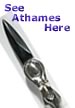
An athame doesn't have to be metal. You can find ones made out of wood or carved stone, if you prefer. It's not used as a physical knife, anyway, but a symbolic one.
Athames hold yang [god] energy.
Athames are used to direct energy, typically in casting ritual Circles and recalling them. They may also be used to cut energetic ties.
Ordinarily, an athame is not used to cut anything on the physical plane.
Bell
 Bells are like the Voice of the Goddess. When you ring one, it brings the Divine's attention to you. And your attention to the Divine!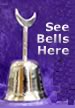
A bell with a lovely tone will call beautiful, healing energy to you. Bells can also be used to clear energy. At the end of a ritual is a good time for this, but if unwanted energy crops up during a ritual, you can use the bell to disperse it.
Candles - Direction Candles
 One candle for each of the directions, colour-coded, are often used on a Wiccan altar. One would go in each appropriate direction . . .
- For North: black, green, or brown
- For East: yellow or white
- For South: red or orange
- For West: blue or aqua
- For Centre, where you aren't using God and Goddess candles: white, silver, or gold.
Candles are used to invoke and hold the Powers of each direction.
Candles - God and Goddess Candles
Often large candles, such as pillar candles, are used to represent the God and the Goddess. These are usually set on either side of the Pentacle, or somewhere in the centre of the altar.
Other options are having just one large candle for the Great Goddess, or three - white, red, and black - for the Maiden, Mother, and Crone.
Where they go is up to you. Somewhere they won't drip onto delicate items or catch things on fire is always good. 
These candles invoke the Energies of the Divine.
Chalice
 The Wiccan chalice is one of the most important altar tools. It signifies the Mother Goddess.
As such, it is a "yin" altar tool.
Some people like very fancy bejeweled cups for their altar chalice, but this is not necessary. A cup or wine-type glass of any material will do, or even a bowl. Something that holds water and, ideally, is round or curvy is good. 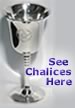
Silver is always nice for Goddess tools - a silver chalice is a perfect Wiccan chalice.
The altar chalice is placed in the West, the direction of Water and the yinnest of the yin.
The Wiccan chalice is used for ceremonial drink, offering libations to the Divine, or holding the salt-water solution.
Deities
 Images or representations of any gods and goddesses who are special to you are always welcome on an altar. Though of course we could not respectfully consider them "altar tools."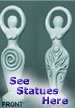
They are more than reminders of Divinity. Statues of the gods and goddesses can actually hold the vibrations of the Divine.
So your altar becomes a living temple - a place where the Divine dwells.
Libation Dish
A small dish, bowl, or cup can go in the centre, ready to receive offerings for the gods and goddesses. (See below.)
You can also use your altar chalice or cauldron for this purpose.
Later, pour or bury the offerings in the Earth, or into living water (rivers, lakes, etc) to carry them to the Divine.
Offerings
 When you would honour the Divine with a gift of thanks or prayer, you can bring them to the Altar as an offering.
Often flowers are kept on the altar as an offering. Anything that is beautiful or special to you, or symbolic of the purpose for the offering, can be offered.
It is probably not necessary to point out that offerings should not be anything that could harm anything (but just in case, I'll point it out anyway).
For one thing, since the Divine lives in all things, anything you harm is an injury to the Divine. And pragmatically, you'll be giving the offerings to the Earth later.
Offerings are one of the most overlooked practices in Wicca today, yet one of increasing spiritual power and importance.
Pentacle
The Pentacle, a 5-point star within a circle, usually is placed in the centre of the altar. The pentacle is one of the most important altar tools, offering protection and power in magickal work.
Salt Water
A small bowl of water with salt dissolved in it, for cleansing. This would be appropriate in the centre. Alternatively, the altar chalice may be used to hold the salt water.
Water and salt are both purifying agents, not only in the physical realm but the energetic as well. Salt water also represents the energies of earth and water united, the ocean womb which gave birth to all life on the planet. So while this may seem an insignificant addition to your altar tools, it holds great power.
Scent or Feather
 Some representation of air, commonly something scented like incense, essential oils, or smudges, or else a flying bird's feather goes in the East, to represent Air.
Sacred scents are used to cleanse an area energetically, call in certain powers, or help witches shift consciousness.
Feathers can also be used to cleanse energy fields, and to fan incense or smudge smoke.
Stones or Crystals
 For the Earth element, in the North, stones and sometimes crystals are used.
These bring in Earth energy, which helps with grounding (except perhaps for quartz crystals). Gem stones also carry certain energies which can be invoked by having them on your altar.
(Another option is to have elements of nature such as plants or animals represent Earth.)
 WITCH TIP: If you choose to use antler, bones, feathers, or other animal parts, be sure to read the precautions at Preparing Your Wiccan Ritual Tools before using them or placing them near your altar!
Wand
 The wand is like a portable, handy version of a broom. There is a theory that originally one instrument performed all the purposes served by the two today.
A wand can be made of any natural material. Wood is traditional. Since all woods have unique Powers, you may like to choose the wood to suit your particular needs.
Wands can be used for divination and channeling magickal energy. They can be used to cast and recall circles, in place of the athame.
The magickal wand goes in the South, for the power of will, magick, and transformation. It also represents yang, or god, energy.
Other Altar Tools
There are additional wiccan tools which may be kept near the altar, or on it, or elsewhere, at the witch's discretion.
Broom
 A broom is not necessarily classified among altar tools, but it is indispensable for energetically cleansing sacred space.
While handy to keep nearby, brooms are usually too unwieldy to put atop an altar.
Cauldron
 Traditionally cast iron, a cauldron is like a 3-legged rounded cooking pot. You can get them in sizes from huge to tiny.
Cauldrons are handy items for burning things, like incense and herbs. This is one of the reasons it is one of the most common altar tools. 
Put an incense charcoal in the bottom, and sprinkle the herbs and powders onto it for very pagan incense.
 (Caution is required when burning anything, of course. Cast iron on legs, if made properly, will keep the heat from the surface it's standing on, but check to make sure. Also be aware of anything flammable nearby or above the cauldron - particularly sleeves and hair!)
Cauldrons can also be used to hold "witches' brews," that is, magickal spells in liquid form. These range from simple salt-water purifications to complex spells.
Working Knife
 A knife you use to cut things, draw lines in the Earth or runes on candles, and other functions. Traditionally the working knife is white-handled.
This knife usually distinct from the Athame, which is a symbolic knife only and not used for other purposes by most witches.
Not all witches count the working knife as one of their altar tools, but just a functional implement.
Sword
Some people like to use a sword for casting in groups. (The difficulty may be emotional safety in addition to physical safety. The symbolic hostility inherent in swords is more than many sensitive people can cope with, especially in as intimate a situation as ritual.)
 Often awkward around an altar, swords may be kept near or under it to be held in the magickal aura.
In the past, swords were the athame of the nobility, but this custom is obviously ridiculous from a spiritual standpoint. Blue blood does not equal spiritual nobility!
Unlike knives, however, swords have no practical use other than as weapons. This link with violence makes swords unadvisable as altar tools for most people.
Other Ritual Items
Altar Cloth
 An altar cloth is optional, but useful. By choosing one color or design, you set the stage for the energy of your altar.
It's also handing on a pragmatic level. It keeps dripping wax from marring your altar top. And since dripping candles are a hazard common to all witches, you may want to choose a cloth that isn't too hard to remove wax from. Or so expensive you'll cry if it gets ruined.
Anything You Want Charged With Magickal Energy.
When you want to charge something with magickal force, you can put it on your altar for a time. A full cycle of the Moon is a standard time frame.
This could be spells, new altar tools, crystals, deities, or symbols of something you would like to have more of in your life . . . whatever would benefit from being infused with spiritual power.
Book of Shadows
 If you have a Book of Shadows it should be kept on your altar, preferably. It is one of your most important altar tools. If your altar is not private enough, or you can't keep it there for another reason, then keeping it under your altar is best.
If you have other books that you use for reference for spells or rituals, it may be handy to keep nearby. It's better to remain within the cast circle than to leave it to look up something.
Spells and Spell Casting Materials
Spells which don't belong elsewhere are usually kept on the altar, and materials for future spells kept within the energy field. They may be stored under the altar or nearby.
Song Books
If you have a collection of song books with chants you like to sing, it's useful keep it close to hand.
Tokens Of Helpers
Your altar is also an appropriate place for symbols of and offerings to any guides or special beings who help you.
Remember the Witch's Silver Rule
And now, having said all about this-goes-here and that-does-that, I would like to reiterate that you can have a powerful and lovely altar without following any rule but one:
Do What Feels Right!
If you don't enjoy it and find it meaningful, if it doesn't carry the energy you want - whether peaceful or stimulating or charged with power or anything else - the Divine will not find it so either.
Make it to please yourself, and you will please the gods as well.
And we always want them to be on our side!
And so, a caveat. . .
Honour Your Heart
Altar tools are symbols, remember. It is the meaning we invest in them that gives them their power.
So listen to your heart; it's the seat of your Power. If something else would be a better symbol for you than what's listed here, it is probably wise for you to use it.
Choose What Suits Your Soul
In all cases, it's inadvisable to use a tool that you have a negative association with. For instance, if knives make you think of violence first and foremost, then find an alternative for an athame . . . . I use a magnificent multi-coloured wooden letter opener for my athame, and it suits my purposes perfectly.
Many witches use items that are especially important to them as their "athames." Starhawk, the writer, apparently uses a pen to cast her circles. A composer friend of mine uses a baton. Others I've seen use feathers, sticks, and crystals. Find what focuses the energy for you.
After all, the gods and goddesses speak to each of us in our own unique language. As in every aspect of Wicca Spirituality, it is what makes your heart sing that is the right thing for you.
But if you're unsure of what to use, the altar tools listed below are good starting points. Once you've used them for a while, you'll begin to sense what tool works well for you.
Pictures of Altars
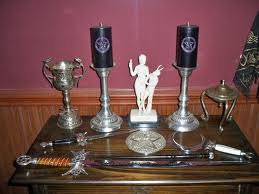
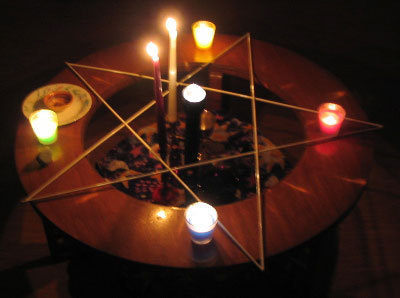
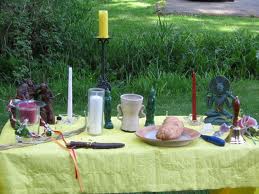
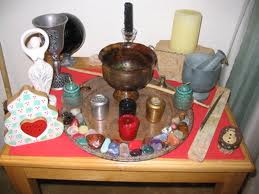
Assignment
QUESTIONS:
1. What is an Athame and its use?
2. What is a Wand used for?
3. What is the use of a Broom?
4. What is the use of a Chalice?
5. What is the use of the Pentacle?
6. What is the use of a Bolline?
7. What is the use of an incense burner?
8 What is the use of a Cauldron?
9. Where can you find Magickal items?